6.3 Sampling
Suppose that we wish to sample, with uniform period \(T\), a continuous-time, band-limited signal. What are the requirements for the sampling frequency \(f_s=1/T\), such that the resulting sequence of samples faithfully represents the continuous signal?
Begin by describing the sampling processes mathematically. Represent sampling in the time domain as the multiplication of the continuous signal by an infinitely long train of equally spaced impulses, as shown in figure 6.8.
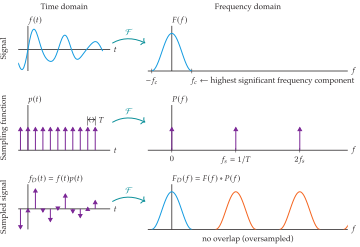
Recall that the Fourier transform of the product of two time functions is the convolution of their corresponding transforms:, the Fourier transform">F \[\begin{aligned} F_d(f)&=\mathcal{F}\{f(t) p(t)\} \\ &= F(f)*P(f)\\ &=\int_{-\infty}^{+\infty} F(f-x)P(x)\, dx,\end{aligned}\] where \(\mathcal{F}\{\cdot\}\) is the Fourier transform operator, \(F(f)=\mathcal{F}\{f(t)\}\), \(P(f)=\mathcal{F}\{p(t)\}\), and \(*\) denotes convolution. As shown, we …
This is a preview. Read the full book in print or ebook — get it from MIT Press (ISBN 9780262548762).
Instructor with access? Instructor login.