Problems
Given the following second-order difference equation, \[\begin{aligned} y(n) & + 0.5 y(n-1) + 2 y(n-2) = \\ & = x(n) + 0.2 x(n-1) + 0.5 x(n-2),\end{aligned}\] find the first five output values starting at \(y(0)\), assuming that the input \(x(n)=1\) for all \(n\) and the output \(y(n)=0\) for all \(n<0\).
Given the following second-order difference equation, \[\begin{aligned} a_0 & y(n) + a_{1} y(n-1) + a_{2} y(n-2) = \\ & = b_{0} x(n) + b_{1} x(n-1) + b_{2} x(n-2),\end{aligned}\] find the discrete transfer function representation with constants \(a_n\) and \(b_n\).
Consider a continuous-time first-order system described by the transfer function, \[ \frac{Y(s)}{X(s)}=\frac{1}{\tau s +1}, \] where \(\tau\) is a constant.
- Using Tustin's method, derive a discrete time transfer function with using a sampling time of \(T=0.1\).
- From the discrete time transfer function, find a difference equation.
Consider the following transfer function of a continuous-time system: \[H(s) =\frac{Y(s)}{X(s)}=10 \cdot\frac{10s+1}{100s+1}.\]
- Using Tustin's approximation, and assuming that the sampling time \(T=2\)s, find the transfer function \(H(z)\) of the corresponding discrete-time system.
- Express the discrete transfer function as the ratio of two polynomials in \(z^{-1}\) in standard form.
- Find the difference equation from the discrete transfer function.
- From the difference equation, find the expression for the current value of the output \(y(n)\) as a function of the current and previous value of \(x\), and previous value of \(y\).
Using the difference equation found in problem 6.3, determine the first five output values starting at \(y(0)\). Assume that the time constant \(\tau=2\), the sampling time \(T=1\), the input \(x(n)=1\) for all \(n\), and the output \(y(n)=0\) for all \(n<0\).
Using your knowledge of floating-point numbers, explain the following:
- Why using a discrete-time transfer function directly could lead to numerical inaccuracies
- How splitting the transfer function into a set of second-order systems fixes this problem
A continuous 1000-Hz sinusoidal signal is sampled (without anti-aliasing filters) with a sampling frequency of 498 Hz.
- Sketch the magnitude spectrum of the sampled signal.
- If the sampled values were connected by straight lines, what would be the apparent frequency of the resulting waveform?
It is often necessary to measure the peak value of a transient (aperiodic) signal. For example, the signal might represent a mechanical variable such as a force, a pressure, or a temperature, that is the result of a singularity function input (e.g., step or impulse). Notice that, because the bandwidth of an aperiodic signal is infinite, the Nyquist-Shannon sampling theorem isn't directly applicable.
Consider a continuous transient signal that consists of a single half-cycle of a sine wave of frequency \(f = 1/T\), shown in figure 6.16.
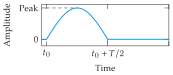
Suppose that we wish to measure the peak value from a periodically sampled record of the continuous signal. The sampling begins at an arbitrary and unknown time \(t_0\). Assume that each point is sampled without error.
Our estimate of the peak value will be (simply) the largest value in the sampled record. Further suppose that we that we want the relative error of the peak estimate to be \(e\), where \(e\) is expressed as a fraction of the half-sine peak amplitude.
By what multiple must the sampling frequency \(f_s\) exceed the waveform frequency \(f\) such that the estimated error is guaranteed to be less than \(e\)?
- Find the general formula for \(f_s/f\) as a function of \(e\).
- Plot \(f_s/f\) over the range \(e\in [0,0.05]\).
- What are the values of \(f_s/f\) for 10, 5, 1, 0.5, and 0.1 percent error?
As part of the control of a process, an analog signal is to be digitized at uniform intervals.
- The continuous signal is band-limited (narrow frequency spectrum), with no significant frequency components greater than 15 kHz.
- The dynamic range of the signal is \(\pm5\) V.
- ADCs are available with resolutions of 4, 6, 8, 10, 12, ... bits.
- The accuracy of the ADC precision voltage reference (referred to the input) is \(\pm0.0002\) V.
- The maximum allowable total error is \(\pm0.002\) V.
Suggest appropriate values for:
- The ADC resolution
- The minimum sampling rate
- The maximum aperture (or conversion response) time