6.4 Discrete-Time Systems
In previous courses, you have likely designed continuous dynamic systems to perform specific functional tasks, such as a controller element of a feedback control system, a low-pass filter, or other signal-processing functions. These systems are often described in terms of their differential equations or transfer functions. In some cases, these devices can be implemented as continuous electrical, mechanical, or fluid physical systems. However, increasingly, such functions are conveniently implemented as computational elements.
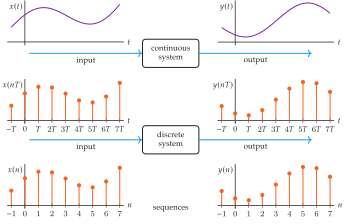
Suppose that we wish to implement a real-time computer system that behaves analogously to a continuous, linear, single-input, single-output (SISO), linear, time-invariant dynamic system. The input and output for the continuous system are continuous functions of time. The corresponding input and output for the real-time system are data, sampled with period \(T\), that form two discrete-time sequences as shown in figure 6.12.
This is a preview. Read the full book in print or ebook — get it from MIT Press (ISBN 9780262548762).
Instructor with access? Instructor login.