Problems
Consider a system with the block diagram shown in figure 8.11.
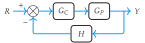
Let \[ G_P(s) = \frac{64}{s^2 + 64 s + 64} \quad \text{and} \quad H(s) = 1. \] Using the integral and derivative compensation technique described in section 8.2, design a PID controller \(G_C(s)\) such that the closed-loop settling time is about \(T_s = 80\) ms, the overshoot is about \(OS = 5\) percent, and the steady-state error for a step input is zero. Using a sampling time of \(T=3\) ms, discretize the system. Simulate and plot the response of the closed-loop system to a unit step command.
With the controller designed in problem 8.1, derive the control effort transfer function. Simulate the discrete control effort for a unit step command.
Develop an alternative controller for the system problem 8.1 using the MATLAB pidtune() function. Design for a closed-loop rise time of \(50\) ms. Discretize the system. Simulate and plot the response of the closed-loop system to a unit step command.
With the controller designed in problem 8.3, derive the control effort transfer function. Simulate the discrete control effort for a unit step command.
Using the root locus methods of section 8.2, design a PID position controller for the T1a specific target system (with a current amplifier). The system parameters are available at https://github.com/rtc-book/source/blob/main/matlab/elmech_params/elmech_params_T1a.mat The design goals are that the closed-loop settling time is about \(T_s\) = 0.20 s, and the overshoot is about OS = 20 percent. Assume that the D compensator zero, \(Z_D = -2\) rad/s. Simulate the closed-loop system and evaluate the performance.
Transform the PID controller design in problem 8.5 to a PIDF design by adding the low-pass filter to the derivative term as described in section 8.4. Assume that the bandwidth of the low-pass filter is \(\omega_b = 136\) rad/s. Simulate the closed-loop system and evaluate the performance.
The current amplifier maintains the commanded output current by altering the voltage across its terminals. However, the maximum voltage is limited by the power supply voltage.
Suppose that the commanded reference input for the design in problem 8.6 is a step of 20 degrees. Simulate the closed-loop amplifier output voltage. Hint: Find the closed-loop transfer functions relating the commanded reference input to (1) the voltage drop across the armature resistance, (2) the voltage drop across the armature inductance, and (3) the back-EMF voltage, \(v_M=K_M\Omega_M\), as in equation (4.34), section 4.3.1. The sum of these three voltages equals the amplifier terminal voltage supplied to the motor. On a single graph, plot all three components and the total voltage.