Problems
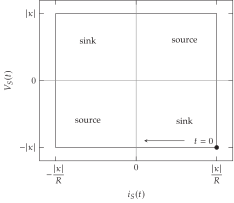
Using the example of figure 4.4 in section 4.3.1, sketch the supply voltage versus the supply current. Plot the supply voltage on the vertical axis, and the supply current on the horizontal axis. Label each quadrant as in figure 4.5. Indicate the initial time and its direction.
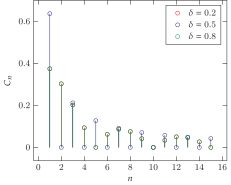
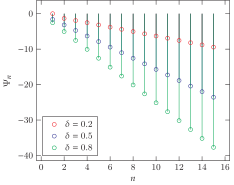
Find the Fourier series of the pulse wave of figure 4.10 for a pulse-wave amplitude \(a\), frequency \(f\), and duty cycle \(\delta\). Compute the positive-frequency amplitude and phase spectrum. Plot the first 15 harmonics with \(a = 1\), \(f = 1\) Hz, and \(\delta = 0.2, 0.5, 0.8\).
First, the period \(T\) of the wave of figure 4.10 can be written in terms of the frequency \(f\), as \(T=1/f\). Similarly, the angular frequency is \(w_0=2\pi/T=2\pi f\). Next, the width of the pulse \(w\) can be written as \(w=\delta/f\). Now, one period of the pulse wave can be written as a piecewise function, \[\begin{aligned} p(t)&= \begin{cases} a & t<w \\ 0 & \text{otherwise} \end{cases}\\ &= \begin{cases} a & t<\delta/f \\ 0 & \text{otherwise} \end{cases}. \end{aligned}\]
We can now begin the Fourier analysis by calculating \(a_0\), \[\begin{aligned} a_0&=\frac{2} {T}\int_0^T p(t)\,dt\\ &=2f\int_0^T \begin{cases} a & t<\delta/f \\ 0 & \text{otherwise} \end{cases} \,dt\\ &=2f\int_0^\frac{\delta} {f}a\,dt\\ &=2\delta a. \end{aligned}\] Next, \(a_n\) can be calculated, \[\begin{aligned} a_n&=\frac{2} {T}\int_0^T p(t)\cos(n\omega_0t)\,dt\\ &=2f\int_0^\frac{\delta} {f}a\cos(2\pi nft)\,dt\\ &=\left.\frac{a\sin(2\pi nft)} {\pi n}\right\vert_0^\frac{\delta} {f}\\ &=\frac{a\sin(2\pi\delta n)} {\pi n}. \end{aligned}\] Finally, \(b_n\) can be calculated, \[\begin{aligned} b_n&=\frac{2} {T}\int_0^T p(t)\sin(n\omega_0t)\,dt\\ &=2f\int_0^\frac{\delta} {f}a\sin(2\pi nft)\,dt\\ &=\left.\frac{-a\cos(2\pi nft)} {\pi n}\right\vert_0^\frac{\delta} {f}\\ &=\frac{-a\cos(2\pi\delta n)} {\pi n}+\frac{a} {\pi n}\\ &=\frac{a} {\pi n}\left(1-\cos(2\pi\delta n)\right). \end{aligned}\]
Now that \(a_n\) and \(b_n\) have been calculated, \(C_0\), \(C_n\), and \(\Psi_n\) can be calculated. First, \(C_0\) can be trivially calculated as \(C_0=a_0=2\delta a\). Next, \(C_n\) can be calculated, \[\begin{aligned} C_n&=\sqrt{a_n^2+b_n^2}\\ &=\sqrt{\left(\frac{a\sin(2\pi\delta n)} {\pi n}\right)^2+\left(\frac{a} {\pi n}\left(1-\cos(2\pi\delta n)\right)\right)^2}\\ &=\frac{a} {\pi n}\sqrt{\sin^2(2\pi\delta n)+\left(1-\cos(2\pi\delta n)\right)^2}\\ &=\frac{a} {\pi n}\sqrt{\sin^2(2\pi\delta n)+\cos^2(2\pi\delta n)-2\cos(2\pi\delta n)+1}\\ &=\frac{\sqrt{2}a}{\pi n}\sqrt{1-\cos(2\pi\delta n)}\\ &=\frac{\sqrt{2}a}{\pi n}\sqrt{2\sin^2(\pi\delta n)}\\ &=\frac{2a} {\pi n}\left\vert\sin(\pi\delta n)\right\vert. \end{aligned}\] Finally, \(\Psi_n\) can be calculated. We will use the \(\text{atan2}()\) function to do this which takes two arguments, \(\text{atan2}(y,\,x)=\text{atan}(y/x)\). This function is well defined for certain edge cases that we run into in this problem. \[\begin{aligned} \Psi_n&=-\text{atan2}(b_n,\,a_n)\\ &=-\text{atan2}(\frac{a} {\pi n}\left(1-\cos(2\pi\delta n)\right),\,\frac{a\sin(2\pi\delta n)} {\pi n})\\ &=-\text{atan2}(1-\cos(2\pi\delta n),\,\sin(2\pi\delta n)). \end{aligned}\]
The amplifude and phase spectra can now be plotted for each of the duty cycles.
A pulse-modulated voltage signal of 50 percent duty cycle is used to power a DC motor and load. Suppose that the system function of the motor/load combination, relating the output speed \(\omega(t)\) to the input current \(i(t)\) can be approximated by a first order system of the form: \[H(s)=\frac{\Omega(s)} {I(s)}=\frac{K} {\tau s+1},\] where the time constant \(\tau=0.01\) s and the gain \(K=5\) (rad/s)/A.
The Fourier series for the pulse modulated signal is: \[i(t) = \frac{C_0} {2} + \sum_{n=1}^{+\infty} C_n \cos(n\omega_0 t+\psi_n)) ,\] where \(\omega_0\) is the fundamental frequency (rad/s), \(C_0=5\) A, and \[C_n=\frac{5} {n\pi}(1 - \cos n\pi)\ \text{A}.\]
Further, suppose that the steady-state ripple in the motor speed caused by the fundamental component (\(n=1\)) of the input must be less than \(\pm 2\) percent of the average response value, \(C_0 |H(0)|/2\).
What is the minimum fundamental frequency \(f_0=\omega_0/(2\pi)\) (Hz) of the pulse-modulated signal?
What is the minimum fundamental frequency \(f_0\) of the pulse-modulated signal, if the requirement was for a \(\pm0.2\) percent ripple?
Find the frequency response function \(H(j\omega)\) of the current-source electromechanical system model of section 4.1.2. Using the T1a specific target system parameters available at https://raw.github.com/rtc-book/source/main/matlab/elmech_params/elmech_params_T1a.mat create a Bode plot.
Find the frequency response function \(H(j\omega)\) of the voltage-source electromechanical system model of section 4.1.1. Using the T1a specific target system parameters available at https://raw.github.com/rtc-book/source/main/matlab/elmech_params/elmech_params_T1a.mat create a Bode plot.
Use the Fourier series of problem 4.2 and the frequency response function of problem 4.4 to perform a steady state Fourier (series) analysis of the response \(\Omega_J(t)\) of the current-source system to the pulse wave \(I_S(t)\) with amplitude \(a=0.05\) A, frequency \(f=500\) Hz, and duty cycle \(\delta=0.5\). Plot the partial sum of the first \(50\) harmonics of the response series.
Use the Fourier series of problem 4.2 and the frequency response function of problem 4.5 to perform a steady state Fourier (series) analysis of the response \(\Omega_J(t)\) of the voltage-source system to the pulse wave \(V_S(t)\) with amplitude \(a=1.2\) V, frequency \(f=100\) Hz, and duty cycle \(\delta=0.5\). Plot the partial sum of the first \(50\) harmonics of the response series.
Model a quadrature encoder as an FSM. Identify the states, inputs, and outputs.
Four states ...
Consider the series of actions controlling the operation of an airplane landing gear. For example, beginning in the "stowed" position, when the cockpit switch is set to "Lower," first the landing gear door opens; and then the gear moves down to the "locked" position. Subsequently, when the switch is set to "Raise," the gears move up and the door closes. See figure 4.21.
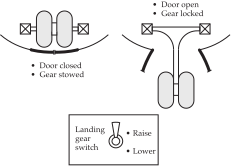
Our task is to design an FSM to produce outputs that actuate the motors that move the door and gear. Inputs to the FSM are from the cockpit switch, and from door and gear position limit sensors.
Operation rules The following are the required operation rules:
When the switch is set to "Raise," the gear moves up to the "stowed" position, and then the door closes.
When the switch is set to "Lower," the door opens, and then the gear moves down to the locked position.
If, while the gear is moving up, the switch is changed to "Lower," the gear should reverse direction and move down to the locked position.
If, while the gear is moving down, the switch is changed to "Raise," the gear should reverse direction and move up to the "stowed" position, with the door closed.
If, while the door is closing, the switch is changed to "Lower," the sequence should reverse: the door opens and the gear moves down.
If, while the door is opening, the switch is changed to "Raise," the sequence should reverse: the door closes.
FSM Inputs There are three inputs to the FSM. The possible values of each variable are shown in brackets.
switch (sw), [raise, lower] A two-position landing gear switch used to command the raising or lowering of the gear.
gear limit sensor (gs), [top, bottom, other] The limit sensor variable gs indicates whether the gear is at the top, at the bottom, or in between.
door limit sensor (ds), [opened, closed, other] The limit sensor variable ds indicates whether the door is completely open, completely closed, or in between.
| When state is | and input is | then output | and make state | |||
|---|---|---|---|---|---|---|
| sw | gs | ds | gm | dm | ||
| GL | ||||||
| GMU | DMC | |||||
| GMU | ||||||
| DMC | GS | |||||
| GS | ||||||
| DMO | GMD | |||||
| GMD | ||||||
| GMD | GL | |||||
| DMO | ||||||
| DMC | ||||||
FSM Outputs There are two outputs from the FSM. Again, the possible values of each variable are in brackets.
gear motor (gm), [raising, lowering, off] The motor variable gm controls whether the gear motor is raising or lowering the gear, or is off.
door motor (dm), [opening, closing, off] The motor variable dm controls whether the door motor is opening or closing the door, or is off.
FSM States At any time, the landing gear control system can be in one of six states. The system remains in a state until conditions are met that cause a transition to another state.
Name the states as follows:
| Gear stowed (up) | GS | |
| Gear locked (down) | GL | |
| Gear moving up | GMU | |
| Gear moving down | GMD | |
| Door moving open | DMO | |
| Door moving closed | DMC |
Creating the State Transition Diagram and Table Perform the following steps to complete the exercise:
Draw the state transition diagram. Use the input, output, and state variable names and values defined here. For each transition, show the event that caused the transition and the output resulting from the transition.
From your diagram, fill in the corresponding state transition table (table 4.4). Again, use the input, output, and state variable names and values defined previously. Use a "\(-\)" to indicate no change in a variable.
The state transition diagram is shown in figure 4.22.
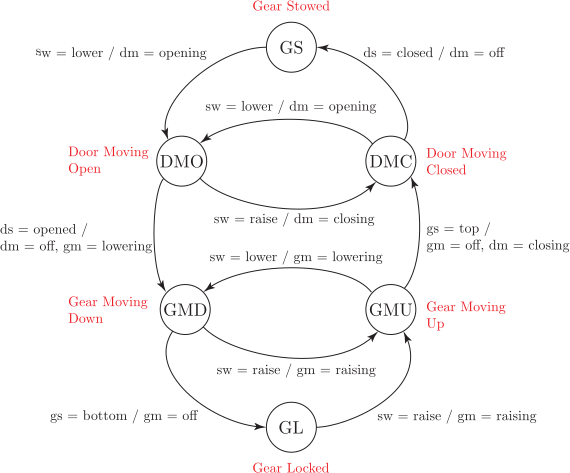
| 1. | gear stowed (up) | GS |
| 2. | gear locked (down) | GL |
| 3. | gear moving up | GMU |
| 4. | gear moving down | GMD |
| 5. | door moving open | DMO |
| 6. | door moving closed | DMC |
The state transition table is shown in table 4.5.
| current state | In: sw | In: gs | In: ds | Out: gm | Out: dm | next state |
|---|---|---|---|---|---|---|
| GL | raise | - | - | raising | - | GMU |
| GMU | - | top | - | off | closing | DMC |
| GMU | lower | - | - | lowering | - | GMD |
| DMC | - | - | closed | - | off | GS |
| GS | lower | - | - | - | opening | DMO |
| DMO | - | - | opened | lowering | off | GMD |
| GMD | raise | - | - | raising | - | GMU |
| GMD | - | bottom | - | off | - | GL |
| DMO | raise | - | - | - | closing | DMC |
| DMC | lower | - | - | - | opening | DMO |