A.1.1 General T1 target system
This section includes a definition of the general T1 target system. For specific hardware instances, see Specific T1 target systems. We define the general T1 target system as follows.
A.1.1.1 target computer: National Instruments (NI) myRIO 1900
The NI myRIO 1900 is a single-board computer. The board uses field-programmable gate array (FPGA)-based fast input/output (I/O). The operating system is the NI Linux Real-Time OS, which is based on the popular Real-Time Linux OS.
Details
System on a chip (SoC): Xilinx Z-7010
Microprocessor: ARM Cortex-A9
Microprocessor architecture: ARMv7
FPGA: Artix-7
Interrupt controller: PL390
A.1.1.2 user interface subsystem
User input device: Keypad
A 16-key keypad. The buttons are momentary contact single-pole single-throw (SPST) switches. The circuitry is arranged in a \(4 \times 4\) matrix and requires 8 digital input/output (DIO) lines to interface.Keys: 16
Switches: Momentary contact SPST
Display: Serial display
Interface: Serial
Encoding: ASCII
Rows: 4
Characters per row: 20
Variables (different for each [specific T1 system](#specific-target-systems-T1))
Baud-rate
Directives
Variables-descriptions
Baud-rate: Display baud rate
Directives: Display directives or escape sequences that have specific functions
Variables-names
Baud-rate: `display_baud`
A.1.1.3 electromechanical subsystem
Board: EM Board
Amplifier: Analog current amplifier
Interface: Analog input
Variables (different for each [specific T1 system](#specific-target-systems-T1))
Gain (A/V)
Max continuous current (A)
Variables-descriptions
Gain (A/V): Amplifier gain in A/V
Max continuous current (A): Amplifier maximum current in A
Variables-names
Gain (A/V): `Ka`
Max continuous current (A): `i_max_amp`
Motor: PMDC motor
Variables (different for each [specific T1 system](#specific-target-systems-T1))
Motor constant (N\(\cdot\)m/A)
Rotor inertia (kg\(\cdot\)m\(^2\))
Damping (N\(\cdot\)m/(rad/s))
Resistance (\(\Omega\))
Inductance (H)
Variables-descriptions
Motor constant (N\(\cdot\)m/A): Motor torque constant in N\(\cdot\)m/A
Rotor inertia (kg\(\cdot\)m\(^2\)): Motor inertia of the motor rotor in kg\(\cdot\)m\(^2\)
Damping (N\(\cdot\)m/(rad/s)): Motor damping estimate in N\(\cdot\)m/(rad/s)
Resistance (\(\Omega\)): Motor terminal resistance in \(\Omega\)
Inductance (H): Motor inductance in H
Variables-names
Motor constant (N\(\cdot\)m/A): `Km`
Rotor inertia (kg\(\cdot\)m\(^2\)): `Jm`
Damping (N\(\cdot\)m/(rad/s)): `Bm`
Resistance (\(\Omega\)): `R`
Inductance (H): `L`
Encoder: Quadrature encoder
Variables (different for each [specific T1 system](#specific-target-systems-T1))
CPR
SPR
Variables-descriptions
CPR: Encoder counts per revolution
SPR: Encoder state changes per revolution
Variables-names
CPR: `CPR`
SPR: `SPR`
Type: Quadrature/incremental
Power supply: DC power supply for amplifier
Variables (different for each [specific T1 system](#specific-target-systems-T1))
Voltage-nominal (V)
Current-max (A)
Variables-descriptions
Voltage-nominal (V): Power supply nominal voltage in V
Current-max (A): Power supply maximum current in A
Variables-names
Voltage-nominal (V): `Vs`
Current-max (A): `Is_max`
Load: Flywheel
A flywheel inertial load.Variables (different for each [specific T1 system](#specific-target-systems-T1))
Inertia (kg\(\cdot\)m\(^2\))
Variables-descriptions
Inertia (kg\(\cdot\)m\(^2\)): Load (flywheel) inertia in kg\(\cdot\)m\(^2\)
Variables-names
Inertia (kg\(\cdot\)m\(^2\)): `Jf`
External-bearings: External bearings
External bearings to support the shaftVariables (different for each [specific T1 system](#specific-target-systems-T1))
Damping
Variables-descriptions
Damping: Estimated damping of the external bearing
Variables-names
Damping: `Bb`
A.1.1.4 prototyping and testing hardware
NAND integrated circuit (IC): A NAND IC with open-collector outputs and transistor-transistor logic (TTL)
Output-type: Open-collector
Logic-levels: TTL
Mechanical switch: Momentary SPDT mechanical switch
Circuit: SPDT
Timing: Momentary
Noncontact tachometer
Oscilloscope
Analog channels: 2
Function generator
Prototyping breadboard
Pullup resistor
Variables (different for each [specific T1 system](#specific-target-systems-T1))
Resistance (\(\Omega\))
Variables-descriptions
Resistance (\(\Omega\)): Pullup resistor resistance in \(\Omega\)
Variables-names
Resistance (\(\Omega\)): `puR`
Pin-to-pin jumper wire
Pin-to-socket jumper wire
Socket-to-socket jumper wire
Male-male BNC cable
Cable impedance: \(50\ \Omega\)
Connector impedance: \(50\ \Omega\)
Male BNC to alligator clip cable
BNC Y-adapter
A.1 Specific T1 target systems
This section includes specific hardware instances of the general T1 target system above (General T1 target system). All hardware is specified, including some suppliers we like.1
A.1.2 T1a: a specific T1 hardware system
T1 system with a Faulhaber motor, Maxon amplifier, Grayhill keypad, and Parallax display.
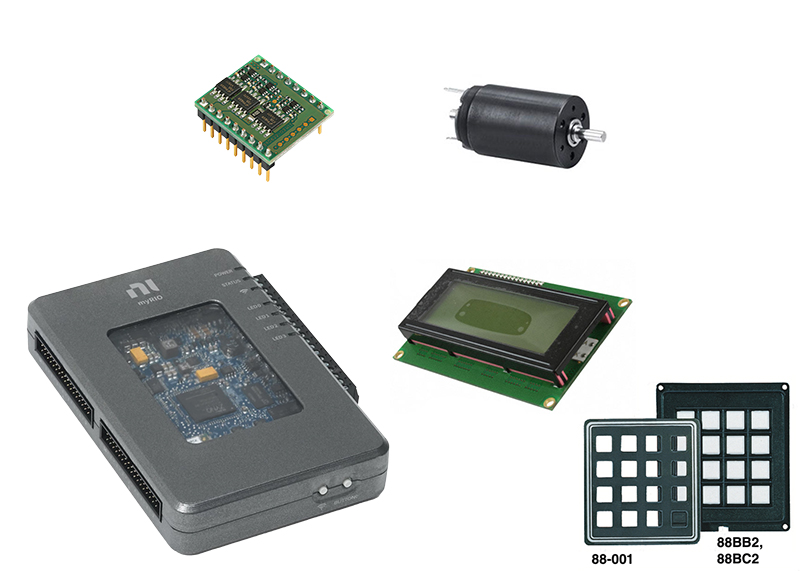
A.1.2.1 Target computer
National Instruments (NI) myRIO 1900
The NI myRIO 1900 is a single-board computer. The board uses field-programmable gate array (FPGA)-based fast input/output (I/O). The operating system is the NI Linux Real-Time OS, which is based on the popular Real-Time Linux OS.
Quantity: 1
System on a chip (SoC): Xilinx Z-7010
Microprocessor: ARM Cortex-A9
Microprocessor architecture: ARMv7
FPGA: Artix-7
Interrupt controller: PL390
A.1.2.2 User interface (UI) subsystem
User input device: Grayhill 88BB2
A 16-key keypad. The buttons are momentary contact single-pole single-throw (SPST) switches. The circuitry is arranged in a \(4 \times 4\) matrix and requires 8 digital input/output (DIO) lines to interface.
Quantity: 1
Keys: 16
Switches: Momentary contact SPST
Setup instructions: [link](/grayhill-88bb2-setup)
Legend sheet accessory for labeling keys: [Grayhill 87AC2046](https://www.digikey.com/en/products/detail/grayhill-inc/87AC2046/255619)
Display: Parallax 27979 LED dot-matrix display
An 80-character LCD transreflective dot-matrix display. It has four 20-character lines and each character has \(5 \times 8\) dots. The serial interface is natural for UART communication. It requires a \(5\) V supply.
Quantity: 1
Interface: Serial
Encoding: ASCII
Rows: 4
Characters per row: 20
Baud-rate: TODO
Directives: TODO
A.1.2.3 Electromechanical subsystem
Board: EM Board T1a
Quantity: 1
Setup details: [Description and Purchasing](/em-board-T1a)
Suppliers1
Amplifier: Maxon ESCON Module 24/2 466023
A small, digital, four-quadrant current amplifier with an analog input. It can act as a controller, but we will use it as a current amplifier (in "current controller" mode). It is compact, light, and relatively inexpensive.
Quantity: 1
Interface: Analog input
Gain (A/V): 0.06
Max current (A, $< 4$ seconds): 6
Max continuous current (A): 2
Analog input voltage range: \([-10,+10]\) V
Power continuous/max: \(48\) W/\(144\) W
Nominal operating voltage \(V_\text{CC}\): \(10\)-\(24\) VDC
Breakout board (not needed if used with our EM Board): ESCON Module 24/2 Motherboard [486400](https://www.maxongroup.com/maxon/view/product/accessory/Starter-kitsEva-BoardsMotherboards/486400){target="_blank"}
Datasheet: [link](/assets/manuals/EN-21-498-500.pdf)
Manual: [link](/assets/manuals/466023-ESCON-Module-24-2-Hardware-Reference-En.pdf)
Setup details: [link](https://rtcbook.org/escon-24-2-setup)
Suppliers1
Motor: Faulhaber 2642W048CR
A small PMDC motor of good quality.
Quantity: 1
Motor constant (N\(\cdot\)m/A): 69.8e-3
Rotor inertia (kg\(\cdot\)m\(^2\)): 11e-7
Damping (N\(\cdot\)m/(rad/s)): 5.3368e-6
Resistance (\(\Omega\)): 23.8
Inductance (H): 2200e-6
Nominal voltage (V): 48
Stall torque (N\(\cdot\)m): 0.137
Shaft diameter (mm): 4
Continuous torque (N\(\cdot\)m): 0.032
Continuous current (A): 0.56
Continuous speed (RPM): 4330
Bearings: Ball-bearings
Mechanical time constant (s): 5.4e-3
Datasheet: [link](/assets/manuals/EN_2642_CR_DFF.pdf)
Suppliers1
Encoder: HEDS-5540-I06
A 512 CPR quadrature encoder.
Quantity: 1
Type: Quadrature/incremental
CPR: 512
SPR: 2048
Channels: 4
Datasheet: [link](/assets/manuals/av02-1046en_ds_hedm-55xx_2014-11-20.pdf)
Suppliers1
Power supply: Alitove 12V 8A 96W Power Supply
Quantity: 1
Voltage-nominal (V): 12
Current-max (A): 8
Connector: 5.5x2.5 mm barrel
Suppliers1
Flywheel: Chuck flywheel (Jacobs 30243)
A drill chuck that serves as a flywheel inertial load.
Quantity: 1
Kind: Flywheel
Inertia (kg\(\cdot\)m\(^2\)): 9.9e-6
Suppliers1
A.1.2.4 Prototyping and testing hardware subsystem
NAND integrated circuit (IC)
Generic—this part is generic and can be substituted with a similar part.
Name: TI SN7438N
Quantity: 1
Output-type: Open-collector
Logic-levels: TTL
Description: This is a chip with four NAND gates, \(5\) V supply (TTL), and open-collector outputs. Get the PDIP package for breadboard prototyping. The 7401 will also work, but we have chosen the 7438 because it is currently more readily available. The 7438 can handle more current, but this is not necessary for our application.
Mechanical switch
Generic—this part is generic and can be substituted with a similar part.
Name: NKK Switches BB15AP-FA
Quantity: 2
Circuit: SPDT
Timing: Momentary
Noncontact tachometer
Generic—this part is generic and can be substituted with a similar part.
Name: McMaster-Carr Noncontact tachometer
Quantity: 1
Suppliers1
Oscilloscope
Generic—this part is generic and can be substituted with a similar part.
Name: Tektronix TBS1052C
Quantity: 1
Analog channels: 2
Bandwidth: \(50\) MHz
Sampling rate: 1 GS/s
Function generator
Generic—this part is generic and can be substituted with a similar part.
Name: Tektronix AFG1022
Quantity: 1
Channels: 2
Bandwidth: \(25\) MHz
Prototyping breadboard
Generic—this part is generic and can be substituted with a similar part.
Name: Global Specialties GS-830
Quantity: 1
Pullup resistor
Generic—this part is generic and can be substituted with a similar part.
Name: CFR16J4K7 through-hole resistor
Quantity: 3
Kind: Pullup resistor
Resistance (\(\Omega\)): 4.7e3
Manufacturer: TE Connectivity Passive Product
Tolerance: \(5\) percent
Power rating: \(1/4\) W
Pin-to-pin jumper wire
Generic—this part is generic and can be substituted with a similar part.
Name: Twin Industries TW-MM-10C
Quantity: 20
Pin-to-socket jumper wire
Generic—this part is generic and can be substituted with a similar part.
Name: Twin Industries TW-MF-30C
Quantity: 20
Socket-to-socket jumper wire
Generic—this part is generic and can be substituted with a similar part.
Name: Twin Industries TW-FF-20C
Quantity: 20
Male-male BNC cable
Generic—this part is generic and can be substituted with a similar part.
Name: Cinch Connectivity Solutions Johnson 415-0198-036
Quantity: 2
Cable impedance: \(50\ \Omega\)
Connector impedance: \(50\ \Omega\)
Length: 3 ft
Max frequency: \(1\) GHz
Suppliers1
Male BNC to alligator clip cable
Generic—this part is generic and can be substituted with a similar part.
Name: Digilent 240-134
Quantity: 2
Length: \(1\) m
Suppliers1
BNC Y-adapter
Generic—this part is generic and can be substituted with a similar part.
Name: Pomona 6754
Quantity: 1